
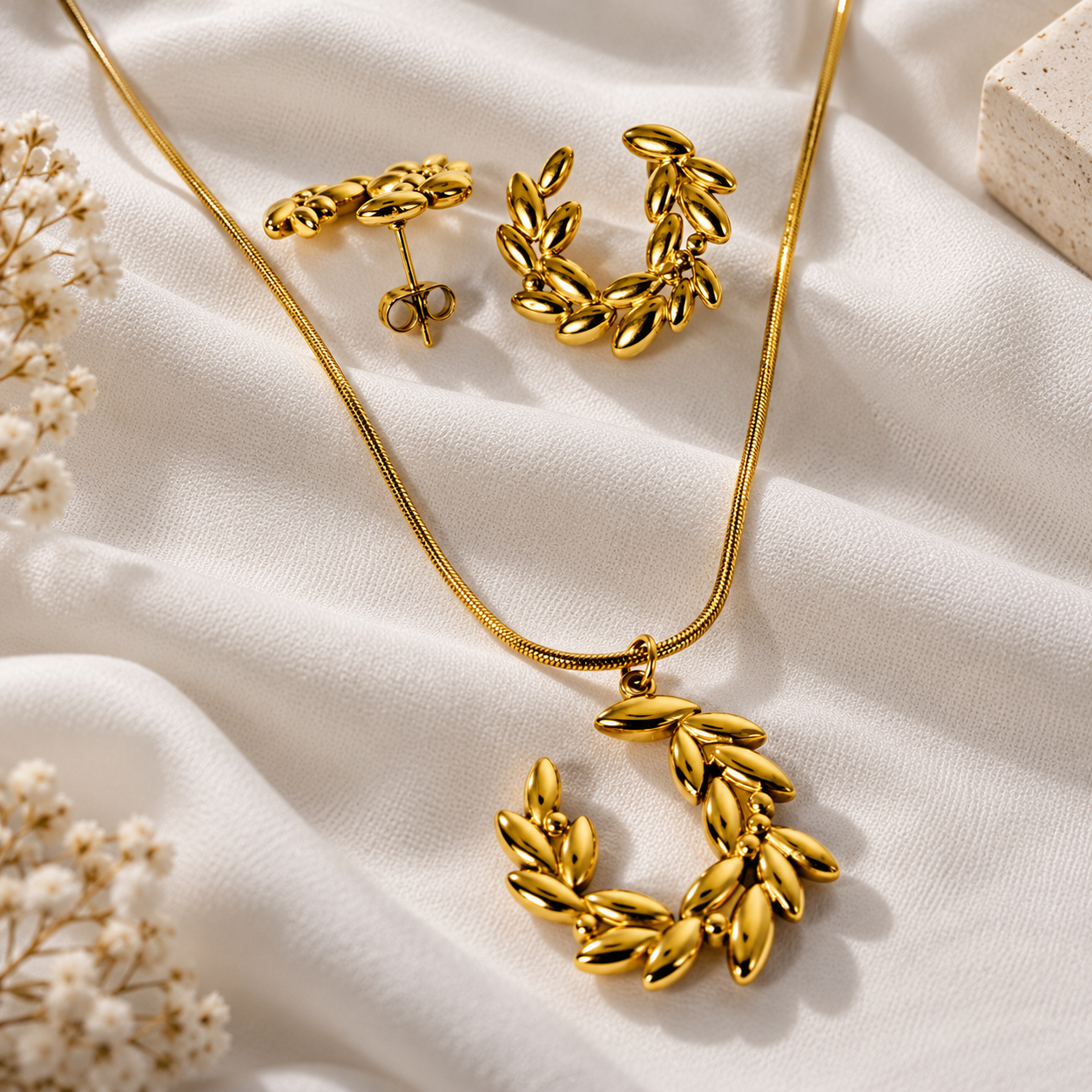
By HERDISE | Jewelry Education & Care Guide
Updated: October 2026
When shopping for beautiful, affordable jewelry, you’ve probably come across the term stainless steel jewelry. But did you know that not all stainless steel jewelry is made from the same grade of metal?
Two commonly discussed grades are 304 stainless steel and 316L stainless steel.
Both offer attractive qualities, but understanding their differences can help you choose jewelry that suits your style, lifestyle, and budget.
At HERDISE, we believe customers deserve beautiful jewelry and honest information about the materials they’re purchasing.
That’s why we’re exploring everything you should know about 304 stainless steel jewelry, including its benefits, durability, corrosion resistance, care requirements, and how it compares with 316L stainless steel.
Whether you’re shopping for a necklace, bracelet, earrings, or a matching jewelry set, this guide will help you make a confident, informed decision.
304 stainless steel is a widely used metal alloy valued for its strength, versatility, and resistance to corrosion.
It belongs to the austenitic stainless steel family and typically contains approximately:
The chromium in stainless steel helps form a thin protective surface layer that reduces the likelihood of corrosion under ordinary conditions.
This protective characteristic makes 304 stainless steel useful in many applications, including fashion jewelry.
In jewelry design, 304 stainless steel can be used to create attractive necklaces, bracelets, earrings, pendants, and coordinated jewelry sets.
Its versatility also allows manufacturers to produce jewelry in various shapes, patterns, and finishes.
For shoppers seeking fashionable accessories without the cost of precious metals, 304 stainless steel offers an appealing option.
Yes! 304 stainless steel can be an excellent choice for affordable fashion jewelry when properly maintained.
It offers several characteristics that make it suitable for necklaces, bracelets, and decorative accessories.
304 stainless steel is a strong metal that can withstand ordinary handling and everyday activities.
Unlike some softer metals, stainless steel provides a sturdy foundation for jewelry designs.
This makes it useful for necklaces, bracelets, and accessories featuring decorative links or geometric shapes.
However, jewelry durability also depends on construction, clasps, decorative stones, coatings, and how frequently the piece is worn.
304 stainless steel can be polished and finished to create beautiful jewelry.
It is commonly used in designs featuring:
These designs allow customers to enjoy stylish accessories suitable for everyday outfits and special occasions.
One of the biggest advantages of 304 stainless steel jewelry is affordability.
Compared with jewelry made from solid gold or platinum, stainless steel fashion jewelry is generally more accessible.
This makes it easier to explore different designs, experiment with new trends, and build a versatile jewelry collection.
At HERDISE, we believe beautiful jewelry should be accessible to customers with different styles and budgets.
304 stainless steel offers good resistance to corrosion in many ordinary environments.
However, stainless steel is not completely immune to corrosion.
Prolonged exposure to saltwater, chlorine, harsh chemicals, and other challenging conditions may affect its appearance.
With proper care, 304 stainless steel jewelry can remain an attractive addition to your accessory collection.
304 stainless steel can be used in many fashionable jewelry styles.
Whether you prefer delicate chains, bold statement pieces, or elegant matching sets, stainless steel provides designers with a versatile material.
This flexibility makes it a practical choice for creating accessories that complement different personalities and occasions.
One of the most common questions jewelry shoppers ask is:
Is 304 stainless steel as good as 316L stainless steel?
The answer depends on how you plan to wear and care for your jewelry.
Both materials offer strength and corrosion resistance, but 316L generally performs better in environments involving saltwater and chlorides.
304 stainless steel is widely used because of its versatility, strength, and corrosion resistance.
316L stainless steel contains molybdenum, an alloying element that improves resistance to certain types of corrosion.
The letter L in 316L means low carbon, a characteristic that helps reduce certain corrosion risks associated with welding and fabrication.
| Feature | 304 Stainless Steel | 316L Stainless Steel |
|---|---|---|
| Strength | Good | Good |
| Corrosion Resistance | Good | Generally higher |
| Saltwater Resistance | More vulnerable | Better resistance |
| Everyday Fashion Jewelry | Suitable | Suitable |
| Typical Material Cost | Generally lower | Generally higher |
| Nickel Content | Contains nickel | Contains nickel |
| Jewelry Care | Recommended | Recommended |
| Common Appeal | Affordable fashion | Enhanced corrosion resistance |
Absolutely not.
304 stainless steel is a legitimate, widely used stainless steel grade with useful properties.
Its main limitation compared with 316L is reduced resistance to certain corrosive environments.
For customers who wear jewelry mainly for work, casual outings, celebrations, or special occasions, 304 stainless steel can be a practical choice.
Customers who frequently expose their jewelry to saltwater, heavy perspiration, or other challenging conditions may prefer the additional corrosion resistance of 316L.
Neither material guarantees that a decorative coating, clasp, or gemstone setting will last indefinitely.
At HERDISE, we believe understanding these differences helps customers select jewelry that matches their needs.
This is another important question.
304 stainless steel does not tarnish in the same way as some traditional jewelry metals, such as sterling silver.
Its chromium-rich protective surface helps resist ordinary corrosion.
However, stainless steel jewelry can still experience discoloration, spotting, surface damage, or corrosion under certain conditions.
The appearance of gold-tone or silver-tone jewelry also depends on the decorative finish applied during manufacturing.
For example, a gold-tone necklace may have a coating that gradually wears with repeated friction or exposure to chemicals.
This does not necessarily mean the underlying stainless steel has corroded.
Several factors may influence how long jewelry maintains its original appearance:
The simplest approach is to treat your jewelry as a fashion accessory that deserves regular care.
Remove it before swimming, showering, or applying perfumes.
After wearing, gently wipe it with a soft, dry cloth.
Store it separately in a clean, dry place.
These habits can help preserve the appearance of both gold-tone and silver-tone jewelry.
Although stainless steel is resistant to corrosion, describing all 304 stainless steel jewelry as completely waterproof would be misleading.
The metal itself can tolerate occasional contact with water under many conditions.
However, repeated exposure to water, particularly saltwater or chlorinated water, can increase the risk of corrosion.
Decorative coatings, adhesives, clasps, and gemstone settings may also be affected by moisture.
We recommend removing your jewelry before showering.
This helps minimize exposure to soap residue, water, and other substances that may affect its finish.
For best results, remove your jewelry before entering swimming pools or the ocean.
Chlorine and saltwater can create more challenging conditions for stainless steel and decorative finishes.
HERDISE Care Tip: Put your jewelry on after applying perfume, lotion, and other beauty products.
304 stainless steel contains nickel.
Although nickel is incorporated into the metal alloy and some tested stainless steel products release relatively small amounts, this does not mean every piece is suitable for every person.
Individuals with nickel allergies or sensitive skin may experience reactions to certain jewelry products.
The actual risk depends on factors such as the alloy, surface condition, coatings, and individual sensitivity.
For this reason, HERDISE does not describe all 304 stainless steel jewelry as nickel-free or guarantee that it is hypoallergenic.
If you have a known metal allergy, consider discussing suitable jewelry materials with a dermatologist.
For earrings and jewelry intended for new or healing piercings, material requirements may be different from those for ordinary fashion accessories.
There is no single lifespan that applies to every 304 stainless steel necklace, bracelet, or pair of earrings.
How long a piece maintains its appearance depends on several factors.
Jewelry worn occasionally may experience less friction and environmental exposure than jewelry worn continuously.
Repeated exposure to sweat, saltwater, and other moisture can affect the condition of the metal and its decorative finish.
The quality of clasps, connecting links, decorative settings, and coatings can influence how well jewelry performs over time.
Cleaning and storing jewelry properly can help preserve its appearance.
The underlying stainless steel and any decorative coatings contribute differently to the jewelry’s longevity.
The key takeaway: 304 stainless steel can provide good service as fashion jewelry, but its lifespan cannot be guaranteed simply because it is stainless steel.
Proper care is one of the easiest ways to protect your favorite jewelry pieces.
Here are seven practical recommendations.
Avoid exposing your jewelry to swimming pool chemicals and saltwater.
Perfumes, cleaning products, bleach, and other chemicals may affect the metal or its decorative finish.
For routine care, wipe jewelry with a clean, soft, dry microfiber cloth.
For uncoated stainless steel, mild soap and water may be appropriate when necessary, followed by thorough drying.
For plated, coated, pearl-style, or stone-accented jewelry, follow the product’s specific care instructions.
Keep individual pieces in soft pouches or separate jewelry box compartments.
This helps reduce scratches and tangling.
Repeated rubbing against other jewelry or hard surfaces can gradually affect decorative finishes.
Avoid pulling, twisting, or sharply bending delicate chains.
Snake chains, in particular, should be handled carefully to prevent kinking.
Consider removing jewelry during strenuous exercise, cleaning, or activities involving repeated contact with hard surfaces.
These simple habits can help your jewelry maintain its attractive appearance.
Both gold-tone and silver-tone stainless steel jewelry offer beautiful styling possibilities.
Your choice ultimately depends on personal preference.
Gold-tone jewelry offers a warm, radiant appearance.
It pairs beautifully with:
Gold-tone jewelry is especially appealing for customers who enjoy warm metallic accessories.
Silver-tone jewelry offers a bright, classic appearance.
It pairs beautifully with:
Silver-tone jewelry is a versatile option for customers who prefer cooler metallic colors.
There is no wrong answer.
Choose the finish that complements your wardrobe and makes you feel confident.
You can also enjoy both finishes and alternate between them depending on your outfit.
Matching jewelry sets offer a convenient way to create a coordinated appearance.
Instead of searching for individual pieces that complement one another, a matching set provides accessories designed to work together.
At HERDISE, our 304 stainless steel fashion jewelry collection includes styles such as:
Sparkling decorative accents create an elegant appearance suitable for celebrations and special occasions.
Modern shapes and polished finishes offer contemporary styling for customers who appreciate clean lines.
Soft pearl-inspired accents create a sophisticated contrast with polished metallic details.
Bold links, decorative patterns, and sparkling accents make statement jewelry an attractive choice for special occasions.
Matching sets also make thoughtful gifts for birthdays, anniversaries, holidays, and other meaningful celebrations.
For many customers, the answer is yes.
304 stainless steel jewelry offers an appealing combination of affordability, versatility, and attractive design.
It provides good strength and corrosion resistance for many ordinary fashion jewelry applications.
Although 316L generally offers enhanced corrosion resistance, that does not mean every customer needs to purchase 316L jewelry.
The best choice depends on your lifestyle, how often you wear jewelry, your sensitivity to metals, and your willingness to follow appropriate care instructions.
For customers seeking affordable accessories for everyday outfits, social occasions, and coordinated fashion looks, 304 stainless steel can be a worthwhile option.
Yes. 304 is an established stainless steel grade widely used in many applications.
Yes. It can be suitable for fashion necklaces, depending on the quality of construction and intended use.
Yes. It is used in various fashion jewelry designs, including bracelets and decorative links.
304 stainless steel resists corrosion but is not completely rustproof. Exposure to salt, chlorine, and certain chemicals can cause corrosion under some conditions.
Neither is universally better for every purpose. However, 316L generally provides better corrosion resistance in chloride-rich environments.
A gold-tone decorative coating may wear or change appearance over time. The rate depends on the coating, frequency of wear, and care.
No. Standard 304 stainless steel contains nickel.
Many 304 stainless steel fashion jewelry pieces can be worn regularly. Proper care and avoiding harsh exposure can help preserve their appearance.
Occasional water contact does not necessarily cause damage, but prolonged or repeated exposure is best avoided, especially for coated or decorated pieces.
Store it in a clean, dry place, preferably in individual soft pouches or separate jewelry box compartments.
Beautiful jewelry is about more than the material used to create it.
It’s about expressing your personality, complementing your favorite outfits, and celebrating the moments that matter.
At HERDISE, we believe customers should have access to attractive jewelry and the information they need to care for it properly.
Our 304 stainless steel fashion jewelry collection brings together contemporary designs, elegant finishes, and affordable styling options.
From sparkling necklace and bracelet sets to modern geometric jewelry, discover accessories that complement your individuality.
Explore the HERDISE jewelry collection and find something that speaks to your personal style.
HERDISE — Your Heart’s Desire.